Perceev dot dev #0

I found a YC startup already building my exact idea. Here is the pivot that gave Perceev its own reason to exist.
For a long time I was hunting for the perfect SaaS. You know the fantasy. The one product that goes viral overnight, goes to 50k MRR, and quietly lets you retire early. I wanted that idea badly, and I spent ages digging through niche after niche looking for the gap that everyone would go crazy over.
Eventually I landed in web analytics, and I convinced myself there had to be a gap in there somewhere that I could fix. The deeper I dug, the more I kept circling back to session replays. And then it clicked. What if a replay tool did not just record sessions, but watched them for you, automatically surfacing the errors and UX issues you would normally never catch, and sent them straight to you? I got genuinely excited. It felt like the gap.
A few more days of research later, I found Lucent. A Y Combinator backed startup doing exactly, and I mean exactly, what was in my head. AI that watches your session replays, finds bugs and UX issues, and pipes them into Slack and Linear, in about thirty seconds if you are already on PostHog. My idea, already built, already funded, already used by real teams, gg.
I’m sure most founders faced this disappointment before.
I built it anyway
As I consistently heard, a proven idea in the market did the validation job for you, so I went for it. A detection engine with a set of hand written detectors, each one looking for a specific known failure. JavaScript errors, rage clicks, dead clicks, network failures, and so on. It worked, for the handful of things I had thought to look for. But sessions are full of problems you did not think to name in advance, and rules only catch what you already know to look for. So I eventually deleted the entire detection engine and let an AI read whole sessions instead, surfacing what actually went wrong rather than what I had pre-decided to hunt for.
That made the product better. It did not make the bigger problem go away.
The crisis
Because the question underneath everything kept getting louder. Why would anyone choose my version over Lucent’s? They do the automated alerting beautifully, they are funded, and they have a head start. Building a slightly different copy of someone else’s product is a slow and quiet way to lose.
I had a full weekend of genuine product existential crisis. Not questioning the product itself, but questioning if it’s worth building in the first place.
The reframe
The thing that finally unstuck me was realizing I had been standing on the wrong side of the problem the entire time.
Lucent, and honestly my original idea too, are built for people who do not want to watch session replays. The whole promise is “do not worry, we will watch for you and just alert you.” That is a great promise, and Lucent owns it.
But there is a completely different person I had been ignoring. The person who actually wants to watch their sessions. Who gets real, irreplaceable insight from seeing how people use their product. Who would happily watch, if only it did not mean scrubbing through every single second of every replay to find the three moments that matter. I faced this problem quite a lot at work while building Helix with my team.
So I stopped trying to win the “you never have to watch” argument. I started building for the people who want to watch, but do not have the time.
The timeline
That reframe is where the timeline came from.
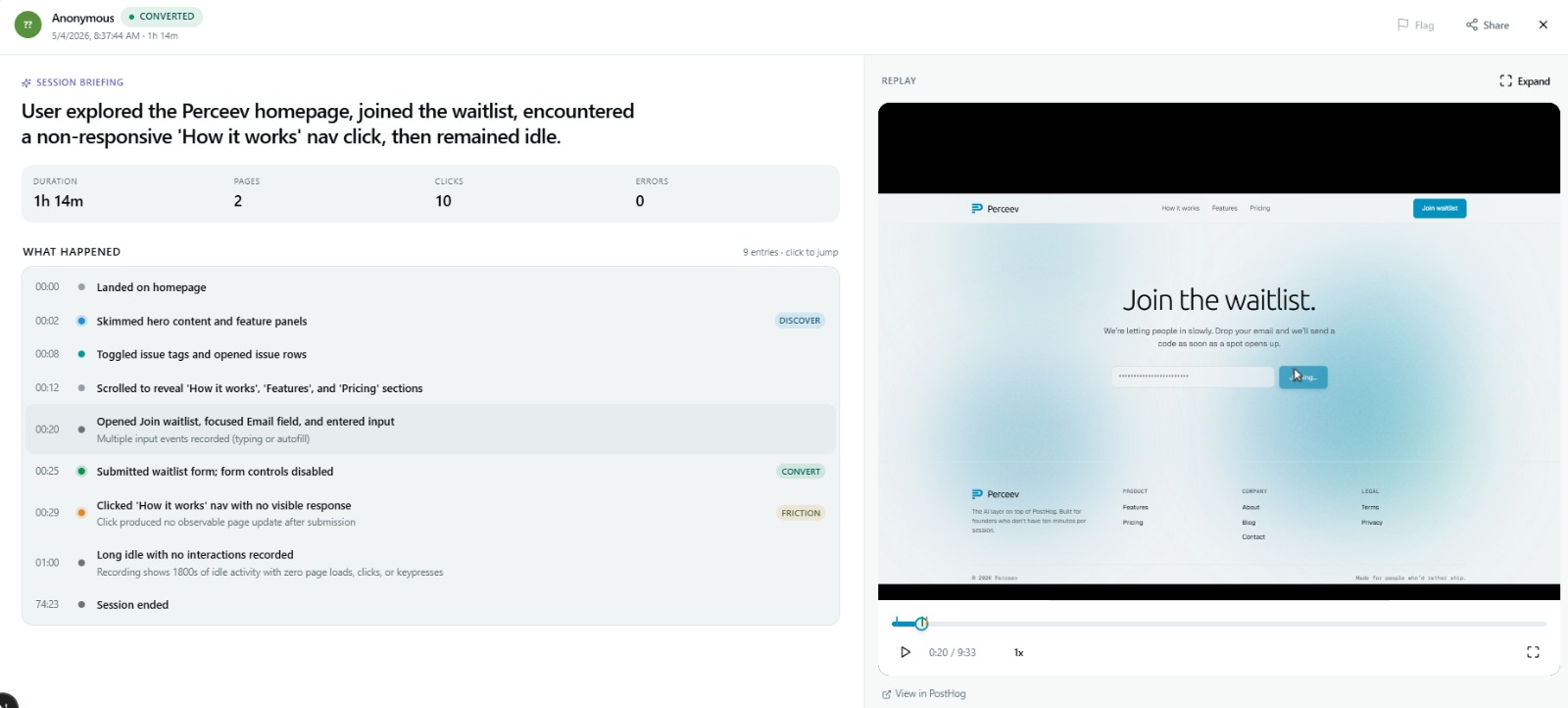 The timeline view (sorry about the image quality). Each marker is a moment worth seeing, so you can read a session without scrubbing it.
Instead of asking you to scrub a replay from end to end, Perceev lays each session out as a skimmable timeline of its key moments. The events that actually carry signal. Where a user got stuck, where something broke, where they hesitated or quietly gave up. You read a session in a few seconds instead of sitting through it in real time. I have not seen it done quite this way anywhere else, though I would not be shocked if someone is, and either way it is the part of the product I am most excited about.
And I did not throw away the automated error capture. It is still in there. I just stopped treating it as the whole product, and started treating it as one feature inside a much faster way to read sessions.
What actually changed
That was the real pivot. Not a rewrite of the code so much as a rewrite of who the product is for. The same underlying engine, a different audience, and a completely different front door. Perceev went from “we watch so you do not have to” to “watch every session in seconds.”
Finding Lucent felt like the end of the idea. It turned out to be the most useful thing that happened to it, because it forced me to stop building a worse copy and go find the version of the product that was actually mine. And I will keep iterating from feedback until it hits the spot.
This is my first post building in public, and I plan to launch Perceev soon. There is a lot I am still figuring out, and this marks the beginning of documenting. More soon.